In northern Montana, sitting below the U.S.-Canadian border, Highway 2 stretches across the flat terrain towards the western mountains. The remoteness of this northern landscape, otherwise known as the Hi-Line, named after the infamous trail in Montana, holds a beautiful history of its people and what is arguably some of the most unique historic beadwork aesthetics of the Northern Plains.
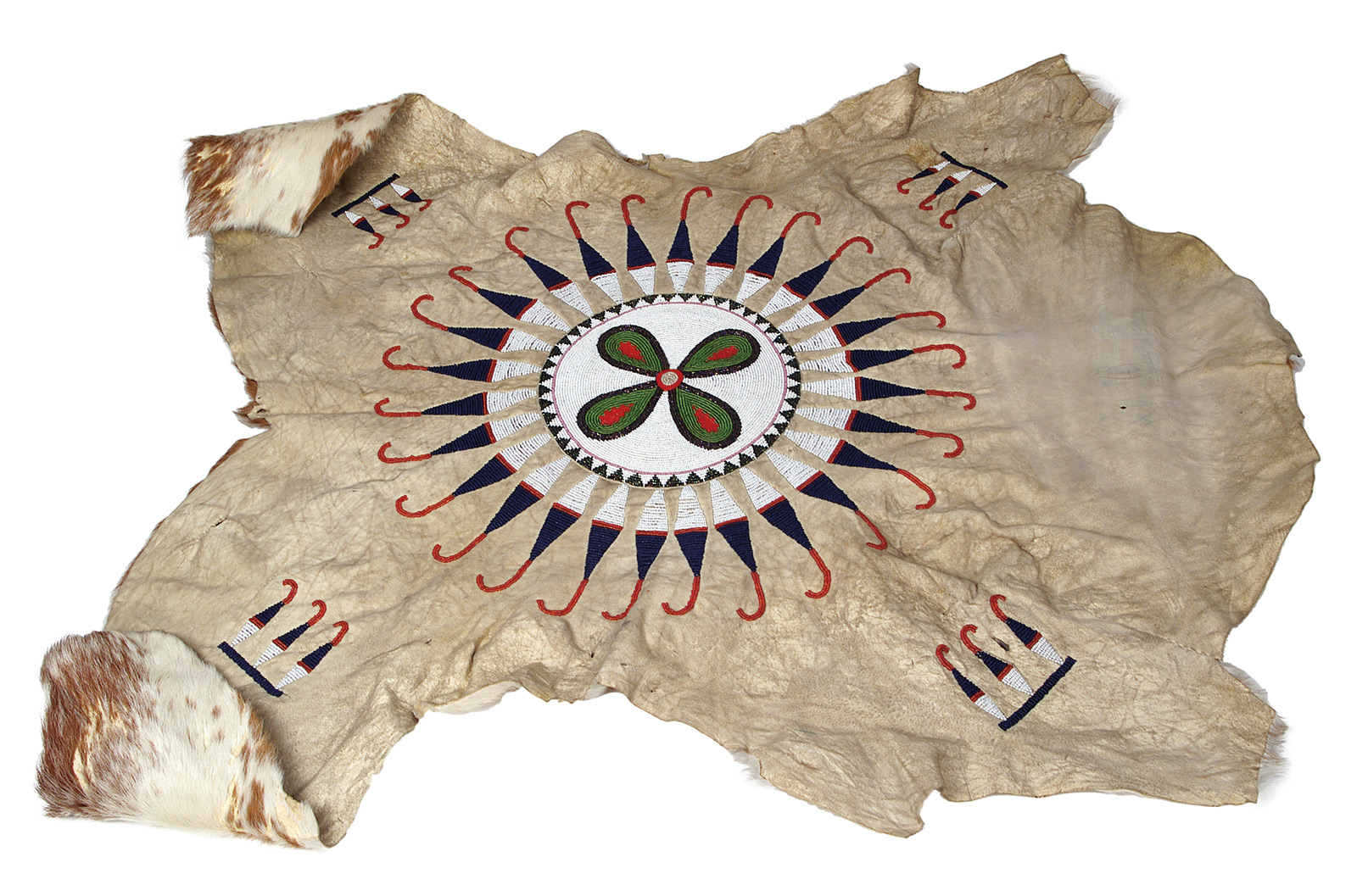 Robe, Assiniboine (Stoney), hide, glass beads, 31 x 38”. National Museum of American India, Smithsonian Institution, 1/2868. Photo by NMAI Photo Services, 22/9525.
The northern Montana territory is traditional homeland of Piikani (Blackfeet) and Nakoda (Assiniboine) people, but migration and reservation establishments have shifted the landscape. Current day reservations that sit along the Hi-Line include, Fort Peck, Fort Belknap, Rocky Boy and the Blackfeet reservation. Each community holds rich, unique tribal histories and cultures that are not only tied to the landscape and natural environments but are also connected to their sociopolitical relationships with neighboring tribes. These relationships and connections can be found throughout historic Hi-Line beadwork color palettes, techniques, designs and materials.
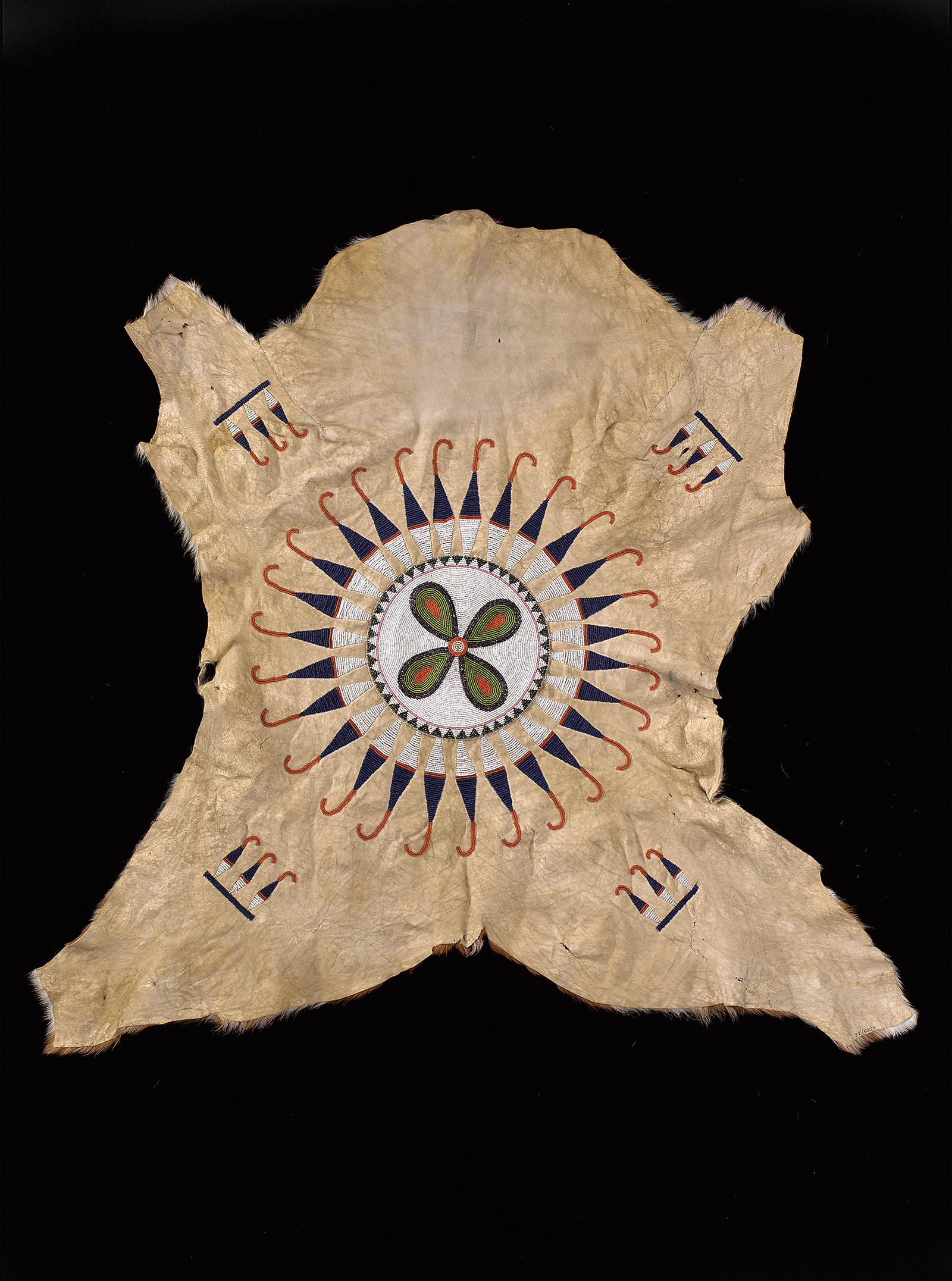 Robe, Assiniboine (Stoney), hide, glass beads, 31 x 38”. National Museum of American India, Smithsonian Institution, 1/2868. Photo by NMAI Photo Services, 22/9525.
When appreciating historic Hi-Line beadwork, there are clear moments of distinct tribal styles, but there are also moments when those lines become blurred, and we see the intertribal inspiration contribute to the overarching aesthetics of the region. For beadworkers, it is a natural process to seek inspiration from their natural environments, as well as their sociopolitical environments. What does the landscape provide? Who are their neighbors? What do they admire in other tribal styles? What can be useful? How can they make it their own? All these factors contribute to the creative process, yet in the Hi-Line territory specifically, these factors have been heightened.
In the far northeast corner of Montana, the Fort Peck reservation carries unique tribal histories that extend into their beadwork aesthetics. Home to the Nakoda and Dakota/Lakota (Sioux) peoples, Fort Peck agency was established by merging multiple bands of Dakota/Lakota peoples migrating from other areas on the Plains, specifically spanning North Dakota, South Dakota and Wyoming, with that of several Nakoda bands. This merging of multiple groups led to a unique process of gaining creative inspiration from each other, something Dakota/Lakota/Nakoda women have always practiced within their beadwork.
Nakoda styles of beadwork employ the bold and heavy geometrics, but their sporadic color palette is often a defining characteristic. The colorful moccasins, pictured here, are a great example of Nakoda geometrics and colors. What often might feel like an uncomfortable color choice for other tribal groups like the Dakota/Lakota, is common trait for Nakoda creatives like the bold placement of yellows, reds, pinks and varying blues. Another common indicator of Nakoda aesthetics would be the dominate use of flat-stitch technique, meaning two needles are employed to guarantee the beads lay flat against the material being used.
When these Nakoda styles merged with Dakota/Lakota peoples in Fort Peck, a unique twist occurred where all former color palettes and geometrics merged to create a new testimony of where the Hi-Line meets the more dominate Northern Plains. An example is Dr. Charles Eastman’s shirt created in 1905 by a Fort Peck woman. The geometrics are common choices of Nakoda, especially of the Hi-Line. Yet, the heavy reliance on blues, specifically the predominate blue that is commonly referred to as “Sioux Blue,” is arguably the Dakota/Lakota influence of Fort Peck.
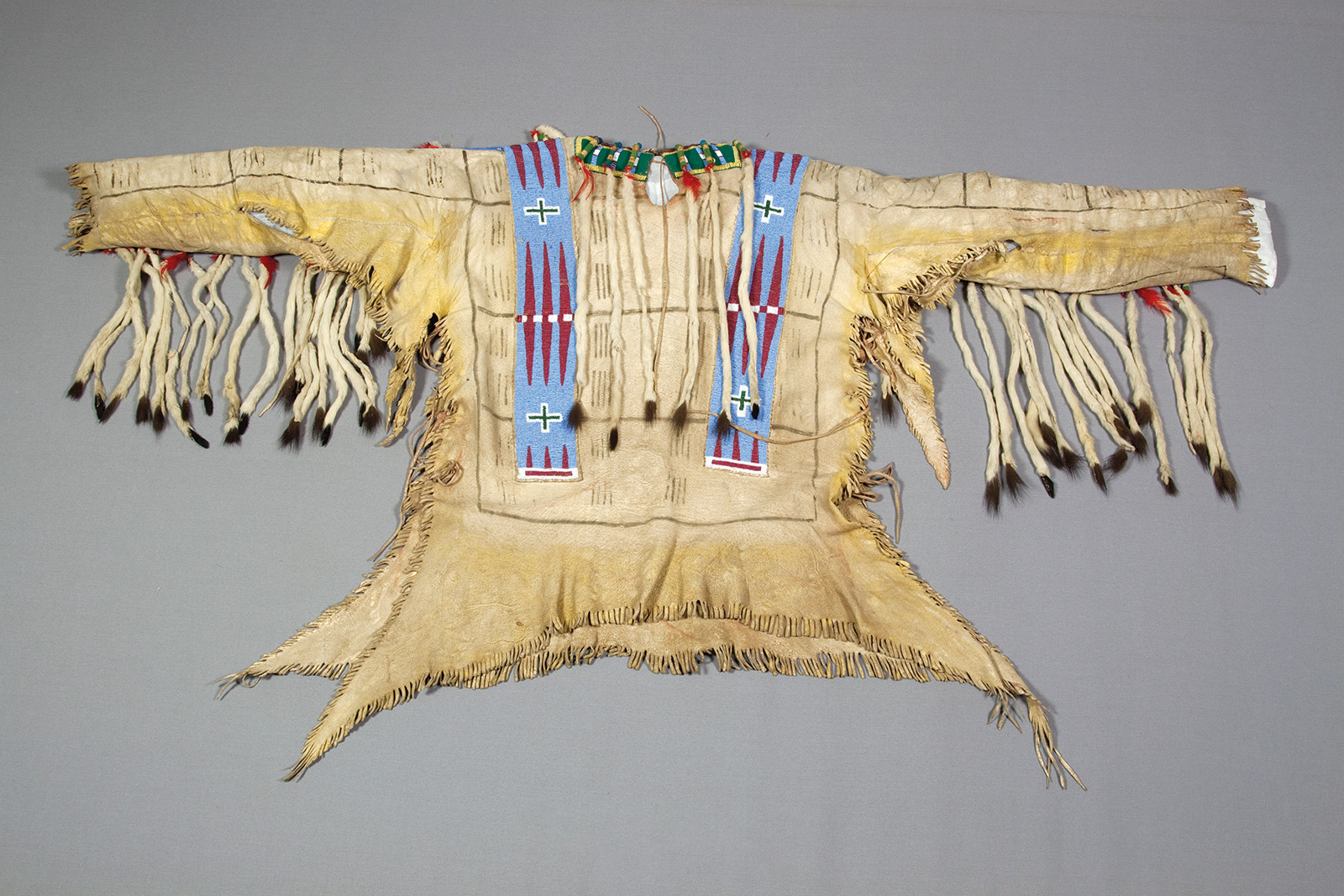 Assiniboine (Nakoda/Nakota/Nakona)/Blackfoot (Niitsitapi) man’s shirt, hide, beads, paint. E357516-0, Department of Anthropology, Smithsonian Institution.
To the west, the Fort Belknap reservation is home to the Nakoda and A’aniiih (Gros Ventre) peoples. The A’aniih migrated to the area with their close relatives the Arapaho (who continued to migrate southwards.) Much like Fort Peck, the merging of two distinctly different tribal groups into the same reservation boundary created a new process of inspiration for each other.
Joe Horse Capture (A’aniiih/Nakoda, Fort Belknap Reservation) reminds us about the significance of A’aniiih beadwork, “Although they share the Fort Belknap with the Nakoda, they have managed to preserve their unique contribution through the use of color including A’aniiih pink, light blues, contrasting with reds and white. A’aniiih works can often be challenging to identity to the non-trained eye because their format does not follow a formulaic configuration that is often found among other tribes on the Northern Plains. This can be attributed to the historic size of the tribe and the lack of meaningful allies throughout their history. That is, there were not many opportunities to form a cohesive style but instead combined unique elements that resulted in what we see today. It’s unfortunate that we cannot find A’aniiih works in museums that predate their reservation period, which makes it difficult to understand what early A’aniiih works may have looked like.”
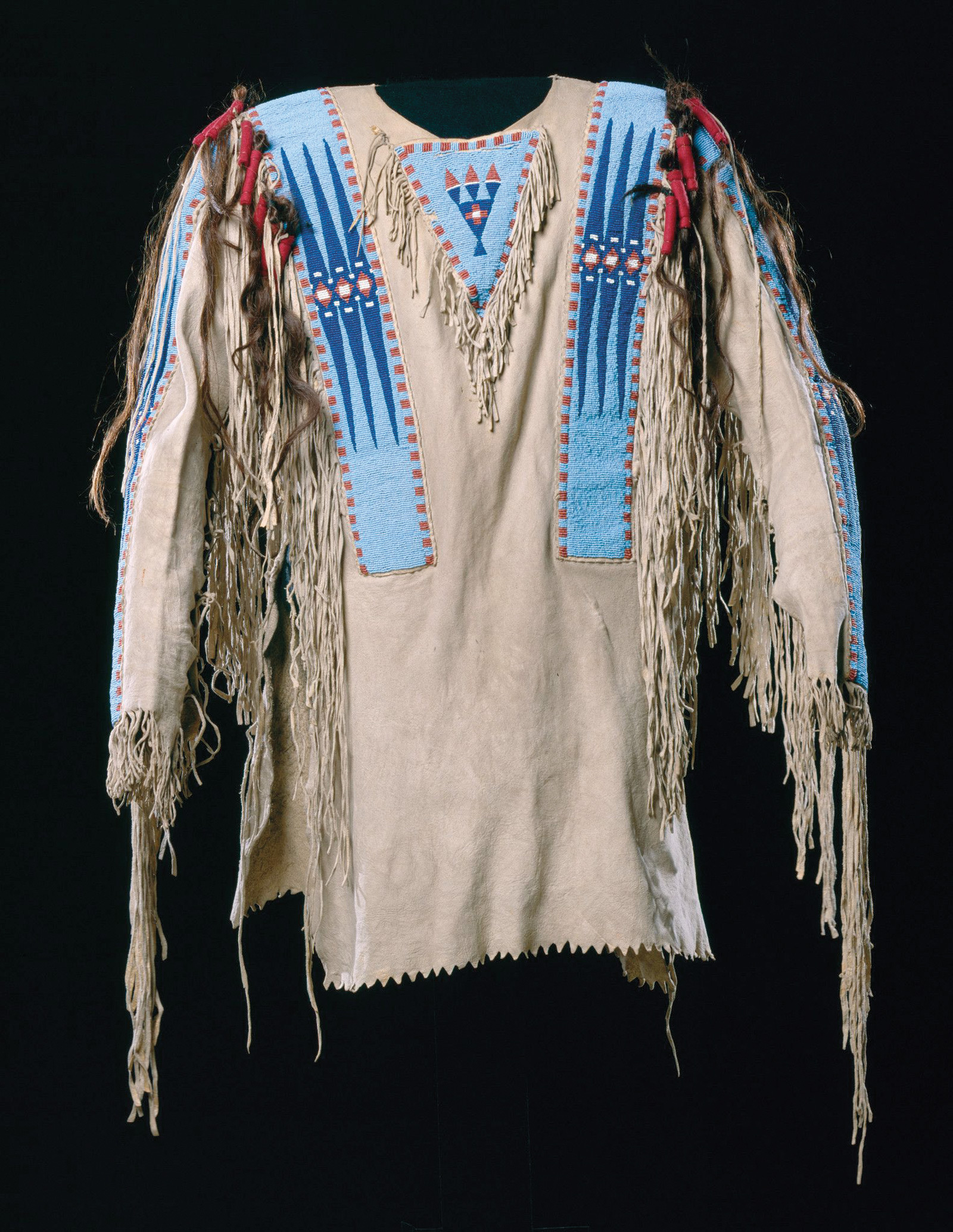 Assiniboine man’s shirt, ca. 1905, doeskin, glass beads, wool cloth, human or horse hair, 29 x 17 x 3”. Gift of Monroe County Historical Commission, 2000.66.1.
Stellar examples of A’aniiih beadwork and creativity can be found in men’s shirts, much like the one shared here. The geometric designs are bold and heavy in comparison to other Northern Plains designs, yet this boldness can be a common indicator of Hi-Line inspiration. Meaning, the line work within the geometrics is a bit thicker than other tribal geometrics, like the Dakota/Lakota. A common feature you find present within most Hi-Line beadwork is the geometric feathers extending outwards from the primary designs, as is seen within this A’aniiih shirt. The placement of geometrics are always well-thought out so that the work is never too busy, but rather evenly weighted enough so that you can appreciate each individual design and color choice.
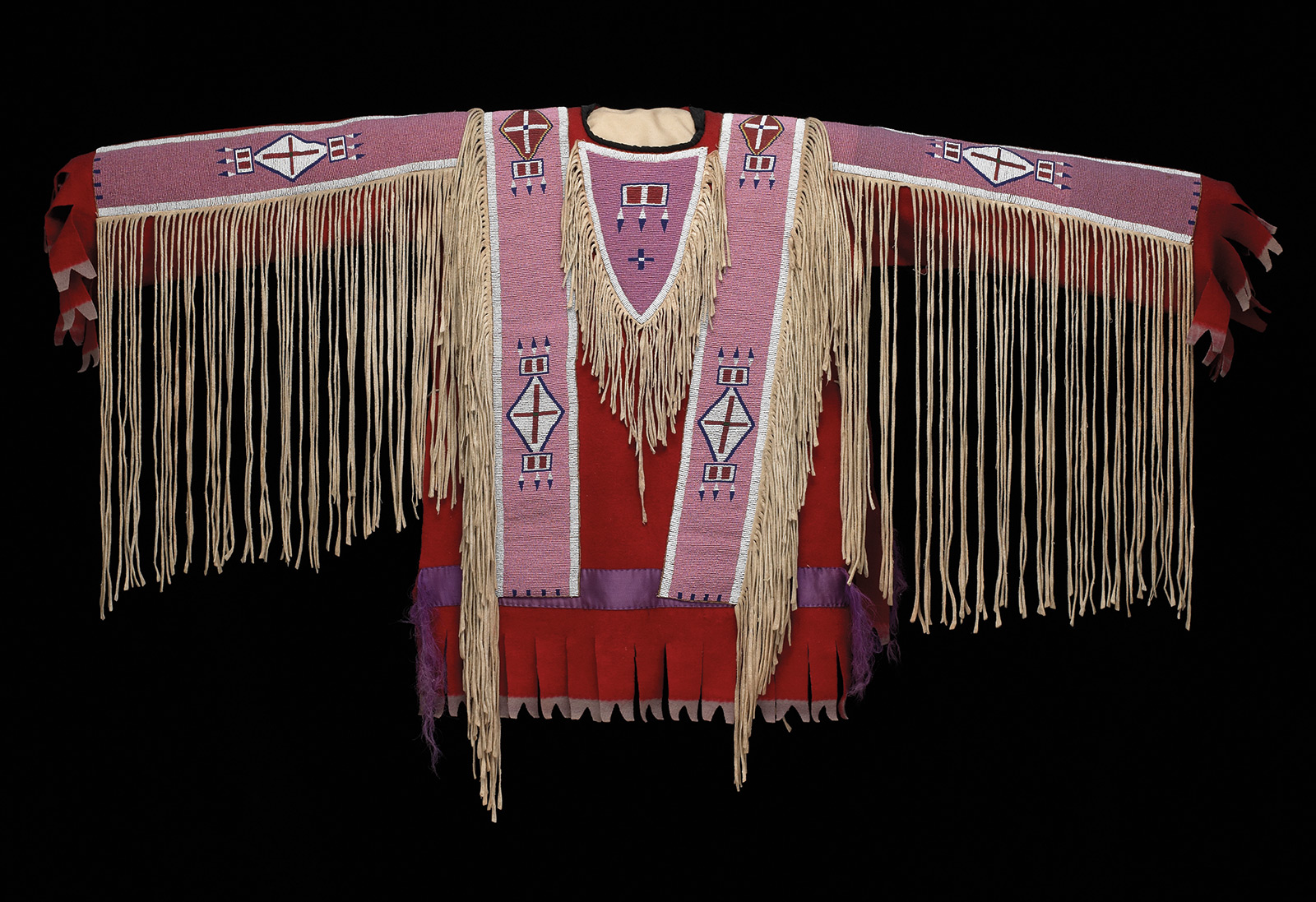 Shirt, ca. 1890, A’aninin (Gros Ventre), wool, beads, animal hide, ribbon. The William Hood Dunwoody Fund and Purchase Through Art Quest 2001, 2001.197. Minneapolis Institute of Art.
The Rocky Boy reservation, westward of Fort Belknap, is home to Ojibwe (Chippewa), Nēhiyaw (Cree) and Metis peoples. Typically acknowledged as the Chippewa Cree, the community of Rocky Boy was also allotted reservation land for relocated Ojibwe’s of the Great Lakes territory. Though Rocky Boy is a smaller reservation, the merging of these tribal groups has contributed to the influence of floral beadwork aesthetics in the Hi-Line and has further inspired new generations of beadworkers that explore floral techniques.
Nēhiyaw offer the Hi-Line floral incorporations to compliment typical geometric languages. This floral influence is also carried as historical memory from the Ojibwe migrating from the Great Lakes. An example of this floral inspiration is the beaded robe completed by Mrs. Speaks Thunder from the Fort Belknap reservation in 1925. As a creator, she employed the geometric feather designs that are common to Hi-Line, yet made a distinct choice to place a floral design in the center. An observation of this choice would be that it is an example of the merging of Hi-Line geometrics and the floral aesthetics of the neighboring reservation of Rocky Boy that influenced her.
The Blackfeet reservation is home to one of the 10 largest tribes in the United States, the Piikani peoples. Bordering Glacier National Park, the Piikani peoples retain oral histories that connect them to the geographical terrain that merges the Great Plains with the Rocky Mountains. Much of Hi-Line beadwork techniques, designs and materials can be traced back to some influence of Piikani people. For instance, Piikani heavily use ermine within their attire This influence has crossed the entire Hi-Line area and can be found within every other tribal groups work. The abundant use of ermine speaks to the geographical terrain of the Hi-Line, tying Indigenous peoples directly to their natural environments and resources.
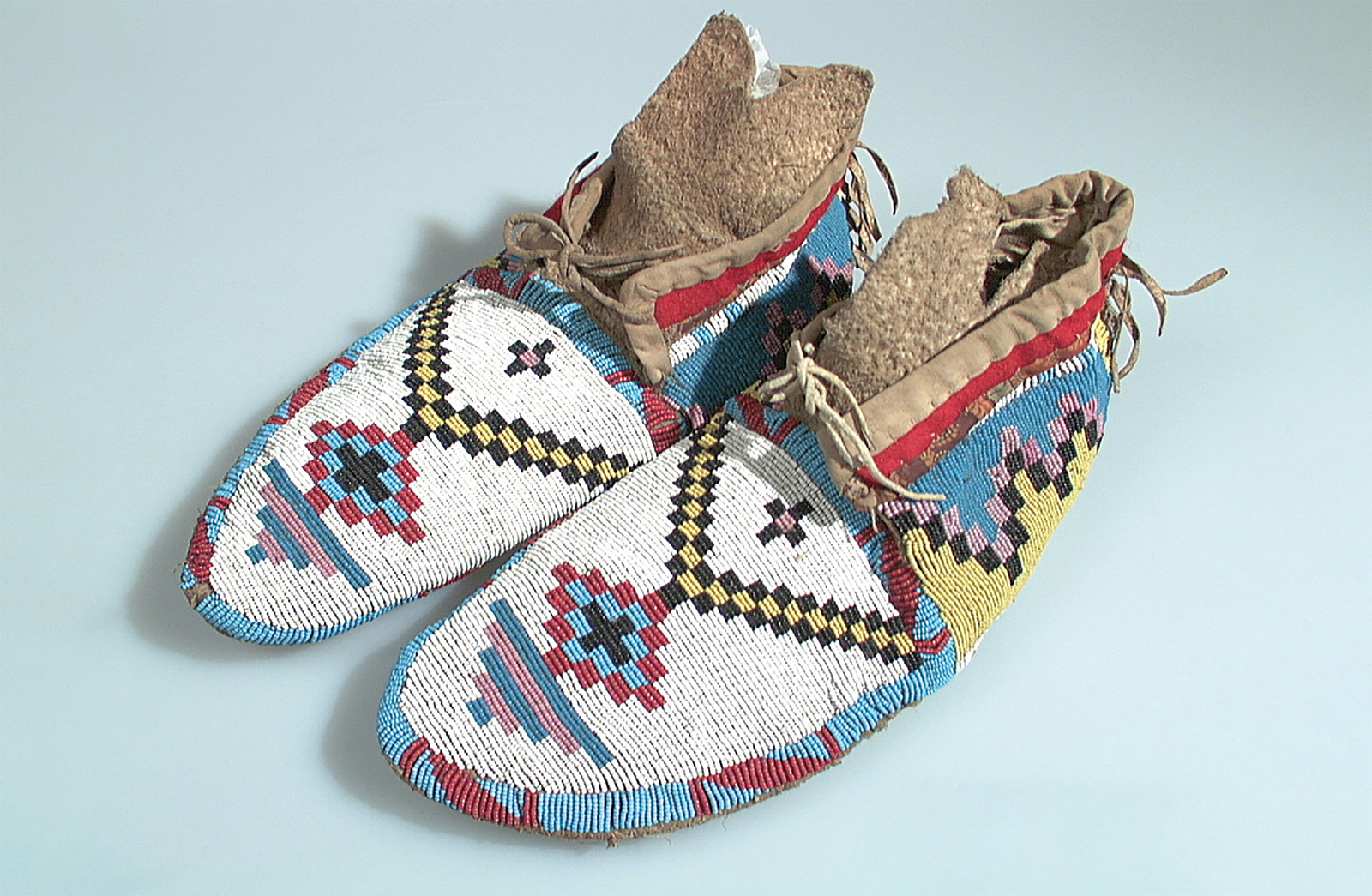 Moccasins, probably Kainai Blackfoot (Kainah/Blood), hide, glass beads, hide thong/babiche. National Museum of American India, Smithsonian Institution, 1/2868. Photo by NMAI Photo Services.
Piikani beadwork aesthetics are composed of elegant color choices, a dash of influential florals, and geometrics that don’t feel quite as bold and heavy as others in the Hi-Line. Whereas Nakoda color palettes can be more sporadic, Piikani colors are more controlled. This Piikani shirt is a great example of the sophistication and intertribal inspiration coming from the Hi-Line area. The distinctiveness of intricate collar work and elaborate use of ermine are definite Piikani traits. Yet, the beaded shirt strips that include the elongated diamonds are common Hi-Line designs that resemble bear claws.
The notable influencers of the converging tribal styles amongst the Hi-Line have created a unique and distinct blend of beadwork colors, techniques, designs and materials. This convergence has ultimately established a beadwork signature style that has evolved as an identifier of this area of the country.
Powered by Froala Editor